

How to Standardize Interviews Across Multiple Hiring Teams


Experience the power of AI-driven video screening and hire faster than ever.
Sign Up Now
Jan 09, 2026 |
Hiring bottlenecks are any constraints in the recruitment process that slow down or block candidate progress. These choke points increase time-to-hire, lead to lost candidates, and gradually damage employer brand. While many teams focus on sourcing or assessments, one of the most common-and overlooked-causes of hiring bottlenecks is far more basic: the interview calendar.
What seems like a simple coordination tool often becomes a silent blocker. Missed availability, endless rescheduling, and delayed interview rounds create scheduling delays in hiring that compound over time. The effects are visible-candidate drop-off, disengaged hiring managers, and roles staying open weeks longer than planned-but the root cause often goes unnoticed. Calendar-driven hiring bottlenecks quietly slow recruitment at scale.
Efficient interview scheduling is not just an administrative task; it is a strategic lever in the hiring process. When scheduling runs smoothly, candidates move predictably through each stage. When it doesn’t, the entire recruitment funnel stalls.
Research consistently shows that faster, more predictable interview timelines improve offer acceptance rates and reduce overall recruitment costs. Even a single delayed interview round can add days to the average time-to-hire and push qualified candidates toward competing offers. At the centre of this dynamic sits the calendar-connecting recruiters, hiring managers, interviewers, and systems.
Calendars do more than record availability; they expose organisational behaviour. Overbooked hiring managers, unclear calendar ownership, distributed interview panels, and manual coordination all introduce friction. In practice, one unavailable interviewer can trigger multiple reschedules, affecting several stakeholders and interview stages at once.
These interview scheduling challenges create cascading delays across the hiring workflow. The result is calendar chaos in recruitment: longer hiring cycles, repeated reschedules, frustrated candidates, and a higher risk of losing top talent before an offer is even made.
Scheduling conflicts are the most visible-and most damaging-calendar-related hiring bottlenecks. Interview panels typically include hiring managers, technical interviewers, and HR stakeholders, each with competing meetings, deadlines, and priorities. When calendars don’t reflect true availability or ownership is unclear, recruiters are forced into manual back-and-forth to find a workable slot.
This constant coordination creates interview scheduling challenges that slow candidate progression and increase disengagement. In one mid-sized technology company we audited, 40% of interview reschedules were caused by conflicts between interviewers, effectively doubling time-to-hire for critical roles. These interview calendar issues are not isolated incidents; they are a core driver of recruitment scheduling delays across growing teams.
Candidates-especially those currently employed-have limited and inflexible availability. When recruitment scheduling prioritises internal calendars over candidate constraints, friction increases and drop-off follows. Delayed responses or rigid interview windows signal inefficiency and reduce perceived employer value.
In competitive hiring markets, the ability to offer interviews within the same week can be decisive. Candidates juggling multiple offers will consistently favour organisations that move quickly and respect their time. As companies scale into high-volume hiring, this challenge intensifies. Without a centralised calendar or clear scheduling workflow, manual coordination struggles to keep pace, directly harming candidate experience and offer conversion rates.
Calendar friction doesn’t just affect candidates-it quietly drains hiring team productivity. Recruiters spend about 35% of their time on interview scheduling, eating into strategic hiring work like sourcing, screening, and candidate engagement. Every reschedule compounds this cost.
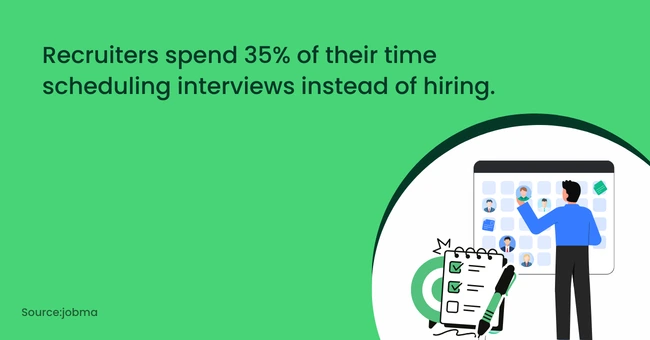
Hiring managers feel the impact as well. Fragmented interview slots break their workday into inefficient segments, increasing context switching and frustration. Research shows that in organisations relying on email and manual coordination, up to 30% of a recruiter’s weekly effort is spent on scheduling alone. This hidden workload slows hiring velocity, reduces team morale, and limits the ability to scale recruitment operations effectively.
Multi-round interview processes amplify hiring bottlenecks caused by calendars. Each stage typically involves different interviewers, evaluation criteria, and availability constraints. When even one stakeholder is unavailable, the entire sequence often stalls.
Consider a senior hire that requires technical evaluation, culture fit interviews, leadership discussions, and an assessment exercise. Coordinating a three- or four-stage process across six or more participants-often spread over multiple teams-creates numerous points of failure. A single delay in one round pushes all subsequent interviews back, turning small scheduling issues into weeks of lost time-to-hire. These interview scheduling challenges are a common cause of prolonged hiring cycles in complex roles.
Calendar bottlenecks become more severe in high-volume hiring scenarios. When organisations need to fill dozens or hundreds of roles, manual interview scheduling does not scale. Recruiters juggling large candidate pipelines against a limited pool of interviewers quickly reach calendar saturation.
Without shared availability windows, batch scheduling, or automation for interview scheduling, the workload multiplies with every new candidate. Seasonal, campus, and frontline hiring teams often experience calendar chaos in recruitment as a result. Many successful organisations address this by using centralised calendars and predefined booking slots, reducing coordination time and helping recruiters close roles faster while maintaining candidate experience.
Distributed and remote teams introduce additional scheduling delays in hiring due to time zones, regional work hours, and cultural expectations. A candidate may only be available during certain hours, while interviewers operate in different time zones with limited overlap. This complexity increases reschedules and lengthens recruitment timelines.
Without clear scheduling guidelines, distributed teams risk creating unfair or exhausting interview experiences-such as late-night or early-morning calls. To avoid these issues, teams need structured scheduling best practices, including time-zone-aware availability, fair interview windows, and shared rules for coordination. Without these safeguards, calendar friction becomes a persistent barrier to scaling remote hiring efficiently.
Overcoming calendar-driven hiring bottlenecks has a direct and measurable impact on hiring speed, candidate experience, and team efficiency. By reducing calendar friction through automation and structured workflows, organisations can streamline hiring without adding recruiter workload.
When calendar bottlenecks are removed, hiring cycles shorten immediately. Faster interview scheduling eliminates idle time between stages and keeps candidates moving through the process while interest remains high. Organisations that adopt calendar automation and structured interview workflows consistently achieve meaningful time-to-hire reduction-often cutting days or even weeks from the hiring lifecycle.
Reducing scheduling delays in hiring also lowers vacancy costs and helps teams secure talent before competitors. Faster interviews create momentum, enable quicker decisions, and prevent strong candidates from dropping out mid-process.
Interview scheduling is one of the most visible touchpoints in the hiring journey. Clear availability options, fast confirmations, and minimal rescheduling signal respect for a candidate’s time. In contrast, calendar chaos in recruitment-missed invites, repeated changes, or long gaps between rounds-quickly erodes trust.
Streamlined recruitment scheduling improves candidate experience by setting clear expectations, providing timely reminders, and reducing uncertainty. Research consistently shows that candidates are more likely to accept offers from organisations that deliver a smooth, predictable interview process and are less likely to proceed when scheduling feels disorganised.
Calendar hiring bottlenecks also limit internal productivity. Manual scheduling pulls recruiters away from high-value work such as sourcing, screening, and candidate engagement. Hiring managers experience fragmented calendars and context switching that reduces focus and decision quality.
By automating interview scheduling and using a centralised calendar, teams can reduce manual coordination and reclaim hours each week. This allows recruiters to scale hiring output without increasing headcount and helps hiring managers concentrate on evaluation rather than logistics. Adopting clear scheduling best practices is one of the fastest ways to streamline hiring at scale.
Technology is the most effective way to eliminate recurring calendar friction. Interview scheduling tools that integrate directly with corporate calendars, expose real availability, and allow candidates to self-book dramatically reduce back-and-forth.
Effective calendar automation should support:
Automation for interview scheduling ensures that when availability changes, interviews can be rebooked quickly without restarting the entire coordination process.
Flexibility reduces reliance on perfectly aligned calendars. Asynchronous interviews-such as one-way video interviews or timed assessments-allow candidates to participate on their own schedule while recruiters review responses asynchronously.
Using asynchronous interviews to avoid scheduling delays is particularly effective in early screening stages. Hybrid models that combine recorded assessments with live interviews reduce interviewer load and help teams speed up hiring workflows without compromising evaluation quality.
A centralised calendar approach creates consistency and predictability. Define clear ownership of interview scheduling, establish shared availability rules, and pre-block interviewer time for active roles. This reduces last-minute conflicts and simplifies coordination.
For complex or senior roles, assigning a single scheduling owner or panel coordinator ensures interviews are confirmed quickly and within defined SLAs-such as 24 hours from shortlist approval. Centralised calendar governance transforms scheduling from an ad-hoc task into a reliable, scalable hiring process.
Calendar-driven hiring bottlenecks are widespread, but they are also highly solvable. The most common challenges-interviewer scheduling conflicts, limited candidate availability, and excessive manual coordination-combine to slow hiring and increase drop-off. Left unaddressed, these issues quietly extend time-to-hire and erode candidate experience.
The solution lies in treating scheduling as a core part of recruitment design. By combining calendar automation, flexible interview formats, and centralised calendar management, organisations can remove friction at every stage. Starting with clear scheduling rules and automation for high-impact roles allows teams to streamline hiring quickly, then scale proven practices across the organisation.
As recruitment teams adopt smarter scheduling workflows and hybrid assessment models, calendar-related hiring bottlenecks will become less frequent. The next phase of improvement will come from tighter integration between applicant tracking systems, interview platforms, and calendar tools-enabling intelligent availability matching, fewer reschedules, and predictive interview planning.
Teams that invest early in scheduling resilience will gain a lasting advantage in competitive talent markets. Faster, more predictable interview timelines not only improve hiring outcomes but also strengthen employer brand and candidate trust.
make scheduling a competitive advantage
If calendar friction is slowing your hiring today, start with a focused audit. Identify which roles experience the most delays, track reschedule reasons, and quantify the time lost to manual coordination. Pilot scheduling automation or asynchronous interviews in these high-impact areas and measure improvements in time-to-hire reduction and candidate experience.
Example: One recruitment team introduced shared two-hour interview blocks for hiring managers and added a one-way video interview for early screening. Within six weeks, average time-to-hire for technical roles dropped by 27%, while candidate drop-off rates were cut in half. The change required minimal policy updates and only a short training session for interviewers.

Hiring bottlenecks are delays in the recruitment process that slow candidate progress, most often caused by interview scheduling issues, interviewer availability, or manual coordination.
Calendars slow hiring when multiple interviewers must coordinate availability, leading to reschedules, idle time between stages, and longer time-to-hire.
Scheduling delays add days or weeks between interview rounds, increasing vacancy costs and causing candidates to drop out or accept faster offers.
Companies can reduce scheduling time by using calendar automation, shared availability windows, and self-service interview booking.
Calendar automation uses tools that sync interviewer availability and allow candidates to book or reschedule interviews without manual coordination.
Yes. Asynchronous interviews let candidates complete interviews on their own time, reducing reliance on live calendar availability.
Disorganised scheduling creates frustration, uncertainty, and disengagement, often leading candidates to withdraw from the hiring process.
A centralised calendar consolidates interviewer availability and booking rules, reducing conflicts and speeding up recruitment scheduling.
Async video screening cuts admin work while improving candidate experience. See personality, communication, and confidence-not just resumes. Try free for your next round.
Create Your First Interview Free2026 © All Rights Reserved - ScreeningHive