

Modern Recruitment Tools for Screening & Executive Search


Experience the power of AI-driven video screening and hire faster than ever.
Sign Up Now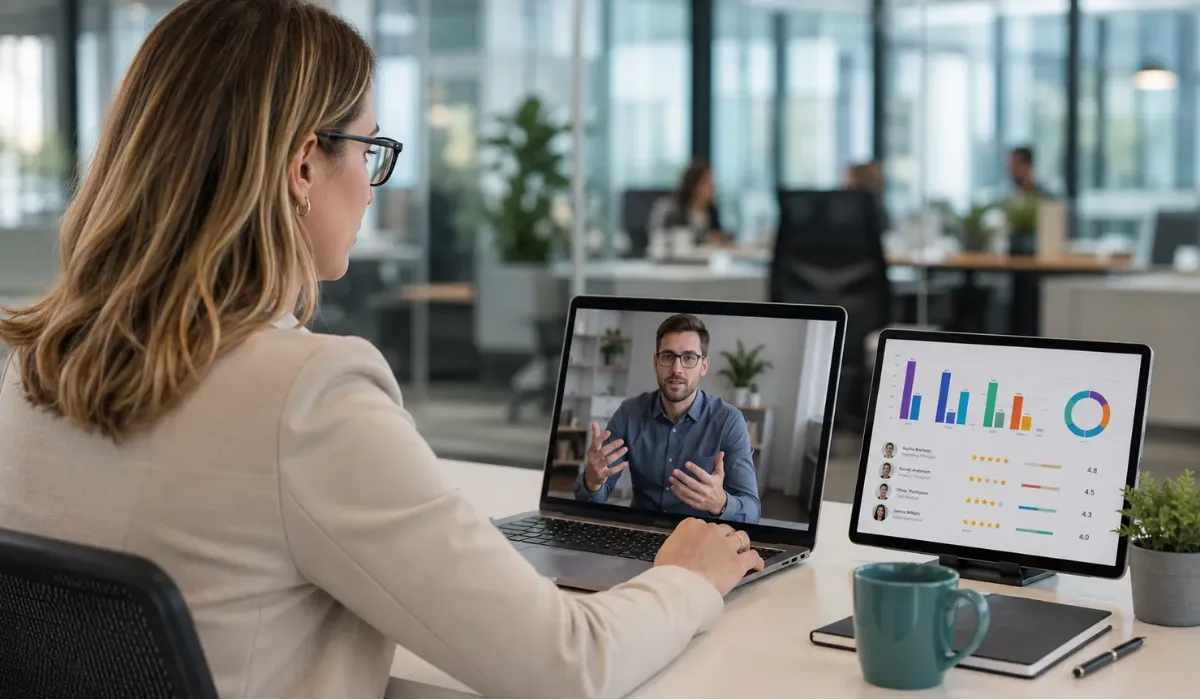
Jul 10, 2026 |
Video interviewing solved a massive logistical headache: it replaced scheduling-heavy phone screens with an asynchronous format candidates can complete on their own time, and recruiters can review on theirs.
The shift makes sense from every angle. Recruiters no longer chase calendars across time zones, and hiring managers get a searchable, comparable record instead of a scribbled notepad and a fading memory of who said what.
But the question worth asking isn't whether to use video interviews. It's what video is being asked to decide, and what makes it work best.
A video interview is excellent at surfacing communication style, confidence, and how a candidate presents themselves. These are exactly the qualities a well-run asynchronous video platform is built to capture quickly and fairly.
What it wasn't designed to measure in isolation is deep, role-specific competence:
This is a question of scope. Composure and articulation are communication skills. However, overall job performance depends on a much broader set of competencies that a 10-minute recording alone cannot capture.
Implementing a validated talent assessment platform adds a structured, benchmarked read on a candidate's hard and soft skills. It measures these traits the same way for every applicant, scoring them against a role-specific baseline rather than a reviewer's personal impression.
This matters because it isn't a technology gap; it's a human variance gap. Even the best video platform with the sharpest questions is still asking a human reviewer to form a judgment from a single, short, one-directional exchange.
Two reviewers watching the same clip will naturally weigh tone, pacing, and eye contact differently:
| Reviewer A's Interpretation | Reviewer B's Interpretation |
| Notices a pause and reads it as hesitation or uncertainty. | Notices the same pause and reads it as thoughtfulness. |
Neither reviewer is wrong, but neither is measuring the same thing consistently across candidates. A cognitive or behavioural assessment removes most of that variance by design, since every candidate answers the same validated items against the same benchmark.
Consider a high-volume hiring pipeline built for enterprise clients hiring 1,000-plus frontline roles a month. Instead of pushing everyone directly to video, an optimised workflow uses a deliberate sequence:
1. Initial Filter: A short screening layer removes candidates who fall below absolute baseline prerequisites.
2. The Data Layer (Assessment): A tailored cognitive, skills, or behavioural assessment produces auto-scored, ranked shortlists.
3. The Human Touch (Video): A structured video interview sits at the end of the funnel as the final, decisive step.
In this model, video isn't the first gate, it's the last one, reserved for candidates who have already cleared a validated bar.
A healthcare BPO serving US hospital networks needed to screen for eight-plus specialty roles (including medical coding, accounts receivable calling, scribing, and radiology support) where a single bad hire is incredibly costly. Getting any of these roles wrong shows up instantly as claim errors, compliance risk, or delayed patient records.
The approach combined an aptitude screen, a CEFR-rated video interview, and proctored domain testing in one workflow. As a result, every candidate's video performance was read against a documented skill baseline rather than judged cold.
Insurance sales tells a similar story. One regional insurer found its interview stage was over-indexing on presentation and under-indexing on sales competency: confident talkers were getting hired, then missing targets.
When moving assessments early in the funnel, HR teams must ensure compliance with EEOC guidelines and global labour standards. Relying solely on unstructured human review of video interviews introduces severe vulnerability to unconscious bias regarding age, gender, accent, or background.
To limit adverse impact and legal risk, use assessments that have been rigorously validated for predictive validity and job relevance. Running regular subgroup analyses ensures that the testing baseline does not disproportionately screen out protected classes. Furthermore, clear candidate experience safeguards, such as accessible formatting and explicit accommodation options, protect fairness while preserving strong data signals.
Adding a talent assessment layer involves a shift from a flat SaaS video licence to either a per-candidate testing fee or an enterprise volume assessment tier. For procurement and operations leaders, the financial trade-offs map out clearly:
To understand the true value of your updated hiring stack, move past vanity metrics like "completed interviews" and focus on these four operational measures:
Video interview screening isn't a problem to solve; it is a strong final step once it is built on the right foundation. The teams getting the best results aren't choosing between video and assessment, they are sequencing them so validated data narrows the field before a fast, structured interview stage gets the final say.
For HR leaders running high-volume pipelines, the practical next step is small: audit where assessment currently sits relative to video in your existing funnel. If it comes after, or not at all, changing that sequence is the fastest way to simultaneously protect quota attainment, lower early attrition, and ease interviewer workload.
No. It means video interviewing does less elimination work and more differentiation work, since the candidates reaching that stage are already pre-qualified.
Video is a strong read on communication, confidence, and presentation, but role-specific skills like cognitive ability, domain knowledge, and behavioural fit need a validated, standardised measurement rather than a single recorded conversation.
Ahead of the video stage, typically after an initial resume or voice screen and before interviews, so video becomes the final validation layer rather than the first filter.
In practice, sequencing assessment before video has been linked to faster time-to-hire, not slower, because interviewers spend less time filtering unqualified candidates and more time on final differentiation.
Time-to-hire, post-hire performance against assessment scores, 90-day attrition, and interviewer time per hire, not just how many interviews were completed.
It's most visible at high volume, where fatigue and pattern-matching creep into manual review, but the underlying issue, presentation being mistaken for competence, shows up at any hiring volume. Smaller teams simply have more room to compensate through longer interviews and more reviewers per candidate.
A skills test measures what a candidate can do today. A talent assessment measures the underlying traits, cognitive ability, behavioural tendencies, and role fit that predict how they'll perform over time.
Async video screening cuts admin work while improving candidate experience. See personality, communication, and confidence-not just resumes. Try free for your next round.
Create Your First Interview Free2026 © All Rights Reserved - ScreeningHive