

How to Standardize Interviews Across Multiple Hiring Teams


Experience the power of AI-driven video screening and hire faster than ever.
Sign Up Now
Nov 26, 2025 |
Modern hiring demands efficiency without sacrificing quality. Behavioral one-way interview prompts have emerged as a game-changer for recruiters seeking meaningful insights while respecting everyone's time. Well-crafted prompts don't just save hours-they reveal authentic candidate competencies, improve response quality, and create fairer evaluation processes. The secret? Brevity paired with precision.
When you write short, focused behavioral interview prompts, candidates respond with clarity and confidence, giving your team the real-world examples needed to make smart hiring decisions. This guide explores proven strategies for crafting concise, impactful prompts that align with both candidate experience and search engine optimization best practices, ensuring your hiring content reaches the right audience while delivering exceptional results.
Behavioral one-way interview prompts are structured questions designed to elicit specific past experiences that demonstrate job-relevant competencies. Unlike traditional inquiries, these prompts ask candidates to share concrete stories about how they've handled real workplace situations. The foundation lies in a simple principle: past behavior predicts future performance. When recruiters ask about actual experiences rather than hypothetical scenarios, they gain authentic insights into problem-solving abilities, interpersonal skills, and professional judgment.
One-way video interviews transform behavioral assessment by combining structured prompts with asynchronous recording technology. Candidates receive pre-recorded questions, think through their responses, and record answers on their own schedule. This format ensures every applicant faces identical prompts under similar conditions, creating objective evaluation standards. A well-designed behavioral prompt might ask: "Describe a time you overcame a major challenge at work." This encourages storytelling while maintaining focus on demonstrable skills rather than interview performance anxiety.
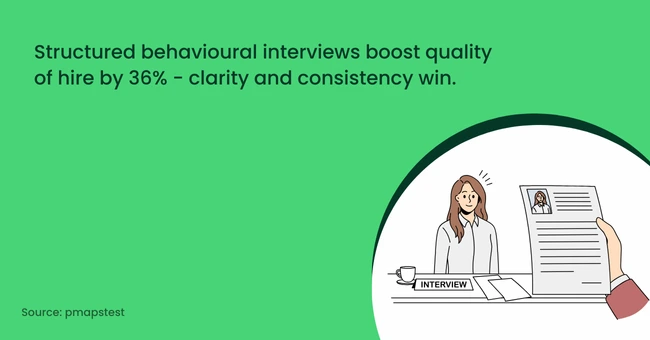
Brevity fundamentally impacts candidate completion rates and response quality. Research consistently shows that concise behavioral interview prompts reduce confusion and increase engagement. When candidates understand exactly what you're asking within seconds, they deliver focused, relevant answers rather than rambling uncertainty. Effective video interview strategies emphasize clarity as the cornerstone of successful screening. In fact, organizations that shift from unstructured interviews to structured behavioral formats report an average 36% improvement in quality of hire, highlighting how clarity and consistency directly impact hiring success.
Best practices center on three principles: eliminate industry jargon, maintain directness, and target specific competencies. Instead of asking "How do you leverage cross-functional stakeholder engagement to drive collaborative outcomes?" simply ask "Tell us about a time you led a project under tight deadlines." The second version cuts through corporate speak to reach the heart of what matters-concrete examples of leadership under pressure. Tech companies increasingly adopt this approach, recognizing that straightforward language attracts diverse talent pools while maintaining professional standards.
The STAR framework-Situation, Task, Action, Result-provides the blueprint for writing effective interview prompts that guide candidates toward complete, structured answers. When crafting your prompts, subtly encourage this format without making it feel like homework. A well-constructed prompt naturally leads candidates to describe context, explain their responsibility, detail their approach, and share outcomes. This structure helps evaluators compare responses objectively across candidates.
Every behavioral prompt should connect directly to job-required skills and organizational values. Start by identifying the top five competencies for your role-perhaps collaboration, initiative, analytical thinking, adaptability, and customer focus. Then craft competency-based interview prompts that target each area specifically. AI-powered recruitment tools can help identify which competencies predict success in similar roles, informing your prompt development strategy.
Avoid yes/no questions or prompts that allow superficial answers. Instead, use open-ended behavioral prompts that require narrative responses: "Share an experience where you had to resolve a conflict in a team." This phrasing invites candidates to paint a complete picture rather than offer bullet points. The difference between "Have you ever managed conflict?" and "Describe how you handled a disagreement with a coworker" is the difference between a checkbox and a character study.
Timing matters tremendously in one-way video interview formats. Keep your recorded prompt under 60 seconds-long enough to provide context, short enough to maintain attention. Candidates should immediately grasp what you're asking without rewinding multiple times.
Always include clear instructions about response expectations. Specify desired length ("Please keep your answer to two minutes"), format preferences, and any particular elements you want covered. These candidate response prompts reduce anxiety and improve answer quality. For example: "Describe a situation that required creative problem-solving and what you did. Please explain the challenge, your approach, and the outcome in about two minutes."
Tone significantly influences engagement. Adopt friendly, professional language that encourages honest, detailed answers rather than rehearsed corporate responses. Phrases like "We'd love to hear about..." or "Share with us..." create conversational warmth while maintaining appropriate boundaries. Enhancing candidate experience during asynchronous screening builds employer brand and increases offer acceptance rates.
A healthcare organization recently implemented these competency-based prompts when scaling their hiring process and reported 40% improvement in identifying candidates who thrived in fast-paced clinical environments. Real-world validation confirms that targeted behavioral prompts outperform generic questioning.
Training hiring teams on prompt clarity and evaluation criteria ensures consistency across your organization. Structured interview approaches require that everyone understands both what prompts seek to reveal and how to assess responses fairly. Create rubrics that define strong, moderate, and weak answers for each behavioral prompt, giving evaluators objective standards rather than subjective impressions.
Standardization dramatically improves fairness and reduces bias in hiring decisions. When every candidate answers identical structured behavioral prompts for interviews, personal chemistry and unconscious preferences carry less weight. Focus shifts to demonstrated competencies and actual track records.
Continuous improvement matters. Review prompt performance quarterly-which questions generate the most insightful responses? Where do candidates struggle with clarity? Gather feedback from both hiring managers and applicants. Optimize your talent selection process by treating prompts as living documents that evolve with your needs and learnings. Finally, support candidate success. Provide preparation resources explaining behavioral interview methodology and offering sample prompts. When applicants understand expectations, they deliver higher-quality responses that better showcase their capabilities. This transparency also improves the overall candidate experience and strengthens your employer's reputation.

Short, clear behavioral one-way interview prompts represent a strategic advantage in competitive talent markets. By focusing on brevity, specificity, and competency alignment, HR teams unlock authentic insights into candidate capabilities while respecting everyone's time. The prompts explored here-grounded in the STAR method, targeted to essential skills, and delivered with professional warmth-transform screening from administrative burden into strategic intelligence gathering.
The evidence speaks clearly: well-crafted behavioral interview prompts boost candidate engagement, enhance evaluation fairness, and predict job success more accurately than traditional approaches. As remote hiring and asynchronous workflows become standard practice, mastering prompt development isn't optional-it's essential. Implement these methods today to build more efficient, objective talent selection processes that identify top performers while creating positive experiences for every candidate who engages with your organization.
Behavioral one-way interview prompts are structured questions used in asynchronous video interviews to assess a candidate’s past experiences, skills, and competencies. They help HR teams gather clear, comparable responses efficiently.
Use the STAR method (Situation, Task, Action, Result), align questions with core competencies, and keep prompts short and open-ended to encourage detailed storytelling and authentic candidate responses.
Clear, structured prompts reduce confusion, encourage storytelling, and highlight relevant skills. Using competency-aligned prompts ensures responses are comparable across candidates and improves hiring fairness.
Keep questions short, focus on competencies, use the STAR method, avoid leading questions, and provide candidates with context or instructions to reduce anxiety. Regularly review prompts for clarity and relevance.
Structured prompts create consistency across candidates, reduce bias, ensure legal compliance, and provide actionable insights for hiring decisions. They help HR teams evaluate responses systematically.
Async video screening cuts admin work while improving candidate experience. See personality, communication, and confidence-not just resumes. Try free for your next round.
Create Your First Interview Free2026 © All Rights Reserved - ScreeningHive