

How to Standardize Interviews Across Multiple Hiring Teams


Experience the power of AI-driven video screening and hire faster than ever.
Sign Up Now
Dec 02, 2025 |
Campus recruitment remains one of the most effective ways to build a strong pipeline of early-career talent. However, traditional campus hiring methods often struggle to keep up with the growing volume of applications, scheduling challenges, and the need for faster decision-making. For organizations running graduate programs and internship initiatives, evaluating hundreds or even thousands of candidates efficiently has become a significant challenge.
This is where one-way video interviews are transforming the hiring process. By enabling asynchronous screening, recruiters can assess candidates consistently, reduce manual effort, and manage high-volume campus hiring without sacrificing quality. Combined with university recruiting automation and structured evaluation criteria, one-way video interviews provide a scalable approach to identifying top talent across multiple campuses.
In this guide, we'll explore practical use cases, proven strategies, and best practices that help organizations modernize campus recruitment and build sustainable graduate and internship talent pipelines.
Scaling campus hiring means recruiting large volumes of students and graduates efficiently without increasing costs or manual effort. For organizations running graduate programs or managing the internship hiring process, scalability is essential to building strong early-career pipelines.
Scale campus hiring refers to the systematic ability to recruit large volumes of entry-level talent from universities and colleges without proportionally increasing time, cost, or resources. As businesses expand and talent needs grow, the pressure to scale campus hiring efficiently becomes a strategic imperative rather than just an operational goal.
In today's competitive landscape, campus hiring scale determines how quickly organizations can build their talent pipeline and maintain their competitive advantage in attracting fresh perspectives and innovative thinking.
Traditional campus recruitment struggles with application overload, manual resume screening, and scheduling constraints. These issues make it extremely difficult to screen students at scale, particularly during peak university hiring seasons.
Without automation, recruiters face inconsistent evaluations, rising travel costs, and extended hiring timelines. These barriers make it nearly impossible to support high-volume campus hiring using traditional methods alone.
One-way video interviews are highly effective for early-stage graduate hiring screening and the internship hiring process. Instead of manually reviewing resumes, recruiters can assess communication skills, motivation, and cultural fit through structured video responses.
Recruiting across multiple campuses requires flexibility. Asynchronous interviews allow organizations to manage high-volume campus hiring efficiently while supporting diverse candidate schedules and locations.
International students, candidates with varying schedules, and applicants from underrepresented backgrounds all benefit from the flexibility these tools provide, contributing to more diverse workplaces while you scale campus hiring operations.
Recorded interviews enable hiring managers, recruiters, and academic hiring partners to collaborate asynchronously. This approach supports university recruiting automation by reducing delays and improving decision alignment.
Teams can share insights, compare notes, and reach consensus without endless scheduling meetings, making it easier to scale campus hiring while maintaining thorough evaluation standards.
Clarify the competencies needed for entry-level and internship roles. Clear criteria improve screening accuracy and reduce bias during graduate hiring screening.
The right video interview platform should support ATS integration, candidate tracking, and reporting features that enable university recruiting automation at scale.
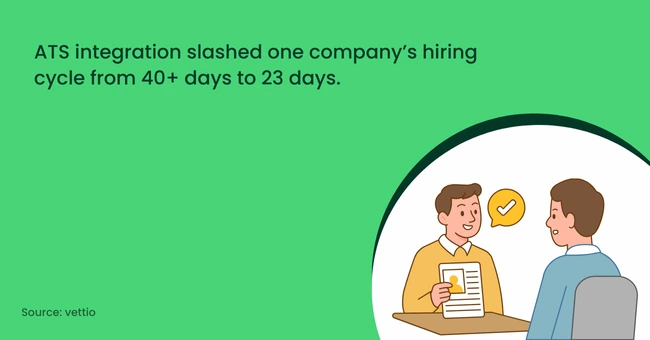
Strong ATS integration can dramatically accelerate your hiring timeline. One organization reduced its hiring cycle from over 40 days to just 23 days after integrating its ATS with interview workflows and assessments, demonstrating the importance of seamless integration for scalable campus recruitment.
Develop behavioral interview prompts that reveal candidate potential while remaining accessible to those with limited work experience. Ensure questions align with your defined success criteria.
Launch your program with clear communication to candidates about expectations and timelines. Measure candidate experience continuously and refine your approach based on feedback.
Effective campus recruitment strategies combine automation, structured interviews, and analytics to support long-term growth in early-career hiring programs.
Clear instructions, flexible timelines, and accessible platforms improve outcomes for candidates, especially during high-volume campus hiring cycles.
Leverage analytics to continuously improve your ability to scale campus hiring. Track metrics like time-to-hire, candidate quality scores, and conversion rates to identify optimization opportunities.
As competition for early-career talent intensifies, organizations need recruitment processes that can scale without increasing complexity or compromising candidate quality. One-way video interviews provide a flexible and efficient solution for managing high-volume campus hiring, enabling recruiters to screen candidates faster while maintaining consistency and fairness.
By combining structured interviews, automation, and collaborative evaluation, companies can streamline graduate and internship hiring programs across multiple campuses. These technologies not only reduce time-to-hire but also improve the candidate experience and support data-driven decision-making.
Organizations that embrace one-way video interviews and university recruiting automation will be better positioned to attract top graduates, strengthen their talent pipelines, and create scalable campus recruitment programs that meet future workforce demands.

Organizations use one-way video interviews, structured assessments, and recruitment automation to evaluate large numbers of candidates without increasing recruiter workload.
Yes. One-way video interviews simplify the internship hiring process by enabling flexible and scalable screening during peak application periods.
University recruiting automation reduces manual work, improves collaboration, accelerates decision-making, and supports large-scale campus hiring programs.
Yes. They provide flexibility, eliminate scheduling conflicts, and allow candidates to complete interviews at their convenience.
Absolutely. One-way video interviews make it easy to evaluate and compare candidates from multiple universities while maintaining consistent assessment standards.
Async video screening cuts admin work while improving candidate experience. See personality, communication, and confidence-not just resumes. Try free for your next round.
Create Your First Interview Free2026 © All Rights Reserved - ScreeningHive